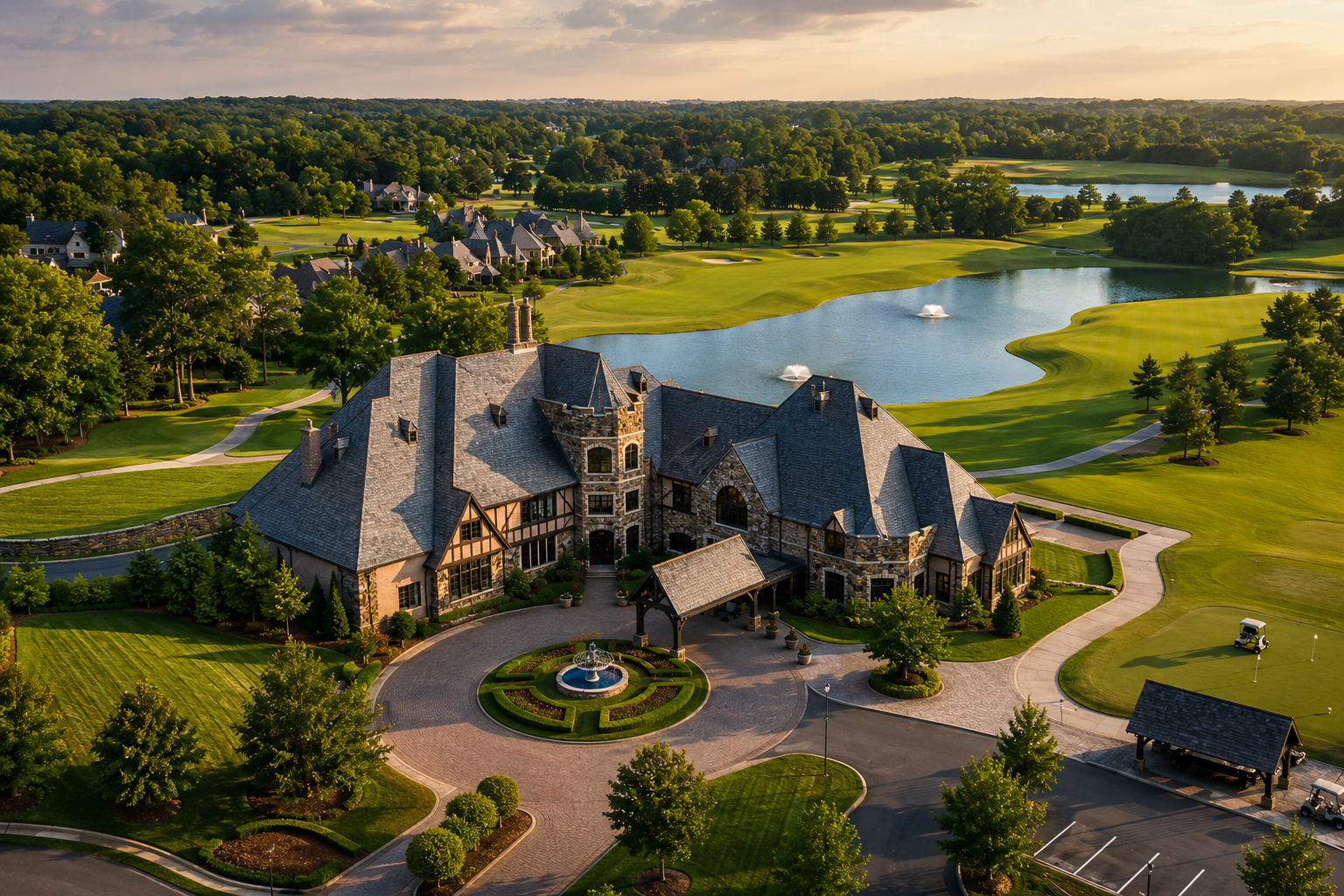
The History of Longview
How a quiet stretch of Union County pasture became one of the Southeast's most distinguished private golf enclaves.
Part of our complete guide to Longview Country Club.
Long before the first drive sailed toward a manicured green, the land that would become Longview existed as a quiet tapestry of rolling Carolina Piedmont. This was Union County terrain, shaped less by grand geological drama and more by the patient hand of time—a landscape of gentle hills, mature forests of oak and hickory, and open pastureland carved out for generations of agricultural use. The topography held a certain subtle promise, a series of rises and falls that could, to a discerning eye, suggest the routing of future fairways. Creeks and tributaries traced paths through the lower elevations, their presence dictating a natural rhythm and flow to the property. It was a canvas not of stark, dramatic features, but of nuanced contours and established natural beauty, a place where the character was embedded in the soil, the slant of the afternoon light through the trees, and the long, uninterrupted views from its highest points. This inherent grace of the land itself would become a foundational element, an integral partner in the dialogue of development rather than a feature to be overcome.
The genesis of Longview in the early 2000s represented a significant departure from the prevailing trends in Charlotte-area luxury development. The prevailing model often leaned toward rapid, expansive construction with a recognizable, market-tested aesthetic. The vision for Longview, however, was predicated on a different set of ideals, drawing inspiration from the timeless estate communities and pastoral villages of Europe. The intent was not merely to build a collection of high-end homes around a golf course, but to cultivate a place with a palpable sense of history and permanence from its very inception. This required a deliberate and patient approach, one that prioritized a cohesive architectural vernacular, the preservation of the land’s most compelling natural features, and the creation of an environment that felt both curated and deeply organic. It was an ambitious undertaking, a commitment to a long-term vision in a market often driven by short-term metrics.
This philosophy demanded a master plan where the landscape, the golf course, and the residences were conceived as a single, harmonious entity. The core idea was to create a community that would appear to have evolved slowly over a great many years, settling into its surroundings with an air of inevitability. The planning process was thus an exercise in restraint and careful orchestration. Streetscapes were designed to meander with the topography, honoring the natural contours of the land rather than imposing a rigid grid upon it. Architectural guidelines were established not to stifle creativity, but to foster a shared language of form, material, and scale, ensuring that each home would contribute to the collective narrative of the community. At the heart of it all lay the golf course, envisioned not just as a recreational amenity, but as the central organizing principle of the entire landscape—a green heart from which the life and character of the community would flow.
The Unfolding Land
The character of Longview is inextricably linked to the physical character of the land upon which it rests. Before development, this expanse of Union County was a study in the subtle grandeur of the Carolina Piedmont. Unlike the dramatic, rocky terrain of the mountains to the west or the flat, sandy coastal plains to the east, this region presents a landscape of soft, rolling hills and broad, mature forests. For generations, it was primarily agricultural land, its contours shaped by the practical needs of farming and husbandry. This history left a legacy of open pastures and fields, interspersed with dense stands of hardwoods that had stood for a century or more. The result was a varied and textured environment, a place of long, open sightlines from the crests of hills, and intimate, enclosed moments within the wooded valleys.
The pre-development topography was not a blank slate but a dynamic canvas. The gentle but persistent rise and fall of the terrain offered inherent opportunities for creating visual interest and strategic complexity. The high points on the property afforded expansive views, which would later become the defining feature of the community’s name and experience. In the lower elevations, small creeks and streams had carved their paths over millennia, creating natural water hazards and wetland areas that would become crucial elements in the ecological and aesthetic fabric of the community. The quality of the soil, enriched by its agricultural past, and the health of the existing forests were also vital assets, promising a landscape that, with care, could mature into a lush and verdant environment.
The decision to build here was a recognition of this latent potential. The vision was not to tame the land, but to enter into a partnership with it. The goal was to lay out fairways, homesites, and roadways in a manner that felt discovered rather than imposed. This required an intimate understanding of the site’s natural systems—its drainage patterns, its soil composition, its dominant tree species, and its response to the changing seasons. The stewardship of these natural assets was a foundational principle, a commitment to preserving the essential soul of the Carolina countryside while layering a new, ambitious vision upon it. The forests, the rolling hills, and the quiet streams were not obstacles, but the very grammar of the place, providing the language that would come to define Longview’s enduring identity.
A European Ideal in the Piedmont
By the turn of the twenty-first century, the Charlotte metropolitan area was experiencing robust growth, with a clear and established pattern for suburban luxury development. The founding vision for Longview was a conscious and decisive turn away from this formula. The ambition was of a different order entirely, rooted in an appreciation for the enduring, multi-generational communities of the European countryside. The objective was not simply to offer exclusivity or high-end amenities, but to create a specific and immersive sense of place, one that evoked a feeling of timelessness and belonging. This was a philosophical choice as much as a commercial one, a belief that true luxury resides in authenticity, craftsmanship, and a deep connection to one’s surroundings.
The 'European-inspired' descriptor, while often used in real estate, was interpreted at Longview with unusual rigor and discipline. It went beyond superficial stylistic references, informing the very structure of the community. The master plan favored intimate, village-like enclaves over sprawling, disconnected estates. It prioritized walkability, with paths and green spaces designed to connect neighbors and encourage a more communal way of life. The architectural ethos was centered on classical traditions, favoring natural materials like stone, wood, and slate, and emphasizing a human scale in the design of both private homes and public gathering spaces. The intent was to build a place that felt as though it had a past, a narrative etched into its very foundations.
This vision represented a significant wager on the discerning tastes of a particular kind of buyer—one who sought not just a home, but an environment. It required a rejection of transient trends in favor of lasting design principles. The community’s founders understood that this approach demanded immense patience and a meticulous attention to detail at every stage, from the initial routing of the roads to the selection of gas lanterns for the streetscapes. It was a holistic vision, where every element was considered for its contribution to the overall narrative. This unwavering commitment to a singular, cohesive ideal is what set Longview apart from its inception and remains a cornerstone of its identity today.
The Signature of a Master
Central to the Longview vision was a golf course that would be more than just a recreational feature; it was to be the heart of the community, the primary organizing element of the landscape, and a work of art in its own right. The choice of a designer was therefore a decision of paramount importance. The selection of Jack Nicklaus, the most celebrated golfer of the twentieth century and a preeminent course architect, was a statement of intent. It signaled an aspiration to create a golf experience of the highest caliber, one that would be recognized and respected by connoisseurs of the game around the world. The commission was not just for a Nicklaus Design course, but for a Jack Nicklaus 'Signature' course, a designation with profound implications.
The 'Signature' designation is a mark of distinction within the Nicklaus Design portfolio. It signifies that Jack Nicklaus himself was intimately involved in every stage of the design process, personally walking the land, shaping the strategy of each hole, and lending his singular expertise to the project. This hands-on approach ensures a level of nuance and strategic depth that is the hallmark of his greatest designs. At Longview, this meant that Nicklaus and his team worked in close collaboration with the land, allowing the natural topography to suggest the flow of the course. The routing takes full advantage of the property's rolling hills and wooded valleys, creating a journey that is both challenging and visually compelling.
The design process was a dialogue between the architect and the landscape. Rather than imposing a predetermined style, Nicklaus and his team sought to discover the course that was already latent in the terrain. Holes were routed to preserve significant tree specimens, to incorporate existing creeks and streams as natural hazards, and to maximize the long-range views from elevated tees and greens. The result is a course that feels deeply rooted in its environment, a natural and inevitable expression of the land. This deep integration of the course into the landscape is a key reason for Longview's cohesive and organic feel; the fairways and greens are not separate from the community but are woven directly into its fabric, creating a seamless and beautiful tapestry of built and natural environments.
First Foundations
The mid-2000s marked the critical phase when the ambitious vision for Longview had to be translated from blueprints and renderings into the tangible reality of soil, stone, and timber. This was the period of the great build-out, a time of intense and carefully orchestrated activity across the property. The first and most complex undertaking was the construction of the golf course itself. This involved a massive earth-moving operation, but one executed with surgical precision, to shape the fairways, tees, and greens according to the exacting specifications of the Nicklaus design while preserving the essential character of the land. It was a delicate balance between creation and conservation, as drainage systems were installed, irrigation laid, and the specific grass varietals best suited to the climate and strategic design were cultivated.
Simultaneously, the foundational infrastructure of the community was laid. Roads were cut, following the meandering paths dictated by the master plan to flow with the land's contours. The architectural guidelines, so central to the community's ethos, were put to their first test as the initial phase of residences began to take shape. This was a crucial moment, as the first homes would set the precedent for all that followed. The emphasis was on authentic materials and high levels of craftsmanship. The sight of skilled masons setting stone, carpenters framing complex rooflines, and landscapers installing the first of thousands of trees and shrubs became the daily tableau. It was a period that affirmed the project’s commitment to quality over speed, substance over superficial style.
This era also saw the construction of the Clubhouse and other key amenities—the physical manifestation of the community’s social heart. The design of these central gathering places was a direct reflection of the overall 'Old World' vision, conceived as a grand manor house that felt both stately and welcoming. The careful siting of these buildings, the selection of interior finishes, and the framing of views out onto the course were all part of the meticulous process of creating a cohesive environment. The early years of construction were not merely about building structures; they were about building character, embedding the founding ideals into the very fabric of the place, and laying a foundation of quality that would prove essential in the years to come.
The Test of Time: Weathering the Downturn
Just as Longview was establishing its identity and hitting its initial stride, the global financial crisis of the late 2000s sent a shockwave through the economy, with the high-end real estate market being particularly vulnerable. For a young, ambitious community like Longview, this period represented a profound and existential test. Development projects across the country stalled or were abandoned, and the very concept of the luxury golf community came under intense pressure. The years that followed were not defined by rapid expansion, but by something far more important: resilience. The community’s ability to navigate this turbulent economic climate would become a defining chapter in its history.
The core principles upon which Longview was founded proved to be its greatest assets during this challenging time. The emphasis on timeless design, quality construction, and a strong, cohesive community vision provided a stability that more trend-driven or speculative projects lacked. The value proposition of Longview was never solely about the ebb and flow of the market; it was about a unique and enduring quality of life. Existing residents who had bought into that vision formed a committed and stable foundation, fostering a sense of shared purpose and stewardship through the uncertain years. The downturn, in a sense, filtered for a population of homeowners who were deeply invested in the long-term health and integrity of the community.
While the pace of new construction inevitably slowed, the period was one of consolidation and maturation. The landscape continued to grow and fill in, the golf course continued to refine its conditioning, and the social fabric of the club continued to strengthen. This period reinforced the wisdom of the original plan. Because the community was not over-leveraged on fleeting trends, it was able to weather the storm without compromising its essential character. For prospective buyers, Longview’s stability during the downturn became a powerful testament to its inherent value and the soundness of its founding ideals. Emerging from the recession, the community did so not with the scars of a survivor, but with the quiet confidence of a place whose quality had been tested and proven.
The Maturation of a Landscape
A community conceived with a long-term vision, as Longview was, reveals its true character not in its first year, but in its second decade. The maturation of its landscape is perhaps the most visible and gratifying expression of this passage of time. The thousands of trees, shrubs, and ornamental grasses that were carefully selected and planted during the initial phases of construction have now had nearly two decades to establish themselves, grow, and transform the environment. The slender saplings that once lined the fairways have become formidable specimens, defining the strategic corridors of the golf course and adding a greater sense of intimacy and scale. The foundational plantings around the residences have softened the architectural lines, nestling the homes into their sites with a grace that only time can bestow.
This evolution is a testament to the foresight of the original landscape design, which was planned not for immediate impact, but for a slow and graceful unfolding. The design ethos emphasized a diverse palette of native and complementary species, creating a landscape that feels both curated and naturally harmonious with its Piedmont setting. The result is a four-season display of color and texture that enhances the beauty of the community throughout the year. The initial investment in a sophisticated irrigation and water management system, integrated with the property’s natural creeks and ponds, has proven to be a critical element in the sustained health and vibrancy of the landscape, even through periods of drought.
Today, a walk or drive through Longview is an experience of a fully realized landscape. The canopy has filled in, creating shaded streetscapes and a palpable sense of enclosure and privacy. The relationship between the built environment and the natural world feels complete and resolved. The architecture, once new and sharp against the backdrop of a young landscape, now appears settled, as if it has been there for a great many years. This maturation is more than an aesthetic enhancement; it is the fulfillment of the original promise to create a community that lives in deep and respectful harmony with its natural surroundings. It is a living, breathing testament to the power of patience and a well-conceived plan.
The Evolution of the Club
The history of a private club is a story of stewardship. While the land and the architecture provide the physical stage, the character and vitality of the club itself are shaped by the evolution of its governance and the ethos of its membership. Over its two-decade history, Longview has navigated the natural life cycle of a premier private community, a journey that has involved the transition from developer ownership to a member-governed model. This evolution is a critical milestone in the life of any club, marking a passage to long-term stability and self-determination. It places the responsibility for preserving the club’s unique culture and standards directly into the hands of those who are most invested in its future: the members themselves.
This transition, handled with care and foresight, has been instrumental in safeguarding the original vision of the community. A member-led board and governance structure ensure that decisions—from capital improvements to the social calendar—are made with the primary goal of enhancing the member experience and protecting the value and integrity of the club. It fosters a powerful sense of ownership and collective responsibility. This model has allowed Longview to be both consistent in its adherence to its founding principles and agile in its response to the evolving desires of its membership. It has facilitated a continuous cycle of reinvestment in the club's assets, ensuring that the facilities and service levels remain at the forefront of the private club world.
The result of this successful evolution is a club with a distinct and deeply ingrained culture. It is an environment that balances a respect for tradition with a forward-looking perspective. The stewardship has been focused not only on the tangible assets of the golf course and clubhouse but also on the intangible qualities that define a great club—camaraderie, a shared passion for the game, and a commitment to a refined and welcoming social environment. The history of the club’s governance is a quiet but essential narrative, a story of members becoming guardians of a legacy, ensuring that the Longview experience will not only endure but flourish for generations to come.
A Course Reaches its Prime
A truly great golf course is a living entity, one that evolves and deepens in character over time. The Jack Nicklaus Signature course at Longview, now two decades from its inauguration, has entered its prime. Its initial strategic brilliance, born from the mind of its master architect and the contours of the land, has been enriched by the maturation of the surrounding landscape. The growth of the fairway-lining trees and native grasses has subtly but significantly altered the strategic calculus of many holes. Gaps that were once generous have become more demanding, and angles that were once open now require more thoughtful navigation. This natural evolution has added a new layer of complexity and nuance to the course, rewarding precise shot-making and intelligent course management.
The commitment to superior agronomy has been a constant throughout the club’s history. The course is maintained in a state of tournament-level conditioning, with firm, fast greens and meticulously managed fairways that allow the ground game to play a significant role, just as Nicklaus intended. This focus on playing surfaces ensures that the architectural merits of the design can be fully appreciated. The greens, with their subtle undulations and varied contouring, are particularly noteworthy, demanding a deft touch with the putter. The strategic bunkering, a hallmark of Nicklaus design, serves to both penalize poorly placed shots and guide the thoughtful player toward the optimal line of play.
The course's reputation has solidified over the years, not through the hosting of major professional tour events, but through a more quiet and substantive appraisal by those who know and appreciate great golf architecture. It is regarded as a 'player's course,' one that can be enjoyed by members of all skill levels yet provides a stern and comprehensive test for the most accomplished golfer. Its routing, which takes players on a journey through the property’s varied environments—from open, hilltop holes with panoramic views to intimate, wooded holes along the creeks—offers a continuous sense of discovery. The course, in its maturity, has fulfilled its promise, standing as the undeniable and enduring heart of the Longview community.
The Architectural Tapestry
The architectural character of Longview is one of its most defining and disciplined features. The community’s aesthetic is rooted in a rich vocabulary of European and American classicism, a deliberate choice to create a timeless and cohesive environment. The design guidelines, established at the outset, have served as the grammar for this architectural language, encouraging a harmonious palette of materials, colors, and building forms. The predominant use of stone, stucco, slate, and wood creates a powerful sense of connection to the natural landscape and an impression of permanence and quality. This shared language ensures that while each home is unique, it is also part of a larger, integrated vision.
Within this established framework, a remarkable degree of architectural diversity and creativity has flourished over the past two decades. The community showcases a sophisticated tapestry of custom-built residences, ranging from grand, manor-style estates to more intimate, village-style homes. Styles draw inspiration from the country homes of France, the rustic villas of Italy, and the stately traditions of English domestic architecture. This variation is not random, but carefully orchestrated. The scale, massing, and siting of each home are thoughtfully considered to respect the topography of the lot and the views of its neighbors. The result is a streetscape that feels organic and varied, as if it has evolved over a much longer period.
As the community has matured, so too has the interpretation of its architectural standards. The first generation of homes established the core identity, and subsequent phases have built upon that foundation, introducing new interpretations and refinements while remaining true to the original ethos. The consistent involvement of a dedicated architectural review board has been critical in maintaining this delicate balance between consistency and individuality. The enduring appeal of Longview’s homes lies in this successful synthesis: a collection of bespoke residences that are at once deeply personal expressions of their owners' tastes and integral components of a singular, artfully conceived community.
Longview in the Regional Context
When Longview was conceived, it was an outlier, a bold proposition in the context of the region’s luxury market. Two decades later, its position is clear and established. It has become a reference point, a benchmark against which other private golf communities in the Carolinas are often measured. This status was not achieved through aggressive marketing or a pursuit of fleeting trends, but through a patient and unwavering commitment to its founding principles of quality, cohesive design, and a premier private club experience. Its history, particularly its resilience through economic cycles, has cemented a reputation for stability and enduring value.
In the broader conversation about luxury living in the Charlotte region, Longview occupies a distinct niche. It appeals to a buyer who is discerning not only about the quality of a home or the prestige of a golf course, but about the integrity of the overall environment. Its success has demonstrated a significant market for a more boutique, curated community experience, one that prioritizes aesthetic harmony and a strong sense of place over sheer scale. The community has become a case study in the power of a singular vision, executed with discipline and stewarded with care over the long term.
The emergence of Longview as a definitive private community has also contributed to the elevation of the entire region's profile as a destination for luxury living. It stands as compelling evidence that a community rooted in classical design principles and a deep respect for its landscape can flourish in the modern South. Its story is one of vision, patience, and execution—a narrative of how a thoughtful and ambitious plan, when nurtured and protected, can culminate in the creation of a truly exceptional place. Longview’s legacy is not just in its beautiful homes and its magnificent golf course, but in its role in shaping the very definition of a premier private community in the twenty-first-century Carolinas.
Questions & Answers
What was the core vision for Longview at its inception?
The founding vision was to create a private, European-inspired estate community that departed from typical regional development. The goal was to cultivate a timeless, village-like atmosphere with a palpable sense of history through cohesive architecture, the preservation of the landscape, and a master plan where the golf course served as the community's heart.
Why was Jack Nicklaus chosen for the golf course design?
Jack Nicklaus was selected as a statement of intent to create a golf experience of the highest international caliber. The 'Signature' designation, in particular, ensured his deep personal involvement in every aspect of the design, lending his unparalleled expertise to shape a course that was both strategically brilliant and deeply integrated with the natural terrain.
How did Longview's architectural guidelines shape its character?
The guidelines established a disciplined architectural language based on classic European and American traditions. By encouraging a consistent palette of high-quality, natural materials like stone, wood, and slate, they fostered a cohesive and harmonious environment, ensuring each custom home contributes to a unified, timeless aesthetic.
What is the significance of the 'Signature' designation on the golf course?
The 'Signature' designation is the highest honor from Nicklaus Design, signifying that Jack Nicklaus himself was intimately involved in the design process. He personally walked the site, routed the holes, and made the key strategic decisions, resulting in a course that reflects his personal design philosophy and expertise.
How has the community's landscape evolved over time?
The landscape, planned for long-term growth, has matured significantly over two decades. Young trees have grown into formidable specimens that define playing corridors and provide privacy, while foundational plantings have softened the architecture, creating a settled, organic environment where the homes feel deeply connected to the land.
In what ways did the community show resilience during economic downturns?
During the financial crisis of the late 2000s, Longview's resilience stemmed from its core principles of timeless design and quality construction, rather than market trends. A committed base of residents and an unwavering focus on the enduring value of the community's vision allowed it to weather the downturn without compromising its essential character or standards.
How is the history of the club reflected in the member experience today?
The club's history, marked by a successful transition to member governance, is reflected in a culture of engaged stewardship. This ensures that the original vision is preserved while allowing the club to evolve to meet member desires, fostering a refined social environment and a continuous reinvestment in the club's world-class assets.
What defines the character of the land on which Longview was built?
The land is defined by the subtle grandeur of the Carolina Piedmont, a landscape of soft, rolling hills, mature hardwood forests, and open pastures from its agricultural past. The development was designed in partnership with these natural contours, allowing the gentle rises and falls of the terrain to shape the community's layout and character.
How has Longview's identity solidified in the Charlotte area?
Longview has solidified its identity by consistently adhering to its founding vision of a boutique, architecturally cohesive community. Its reputation for quality, stability, and a premier private club experience has made it a benchmark for luxury living, appealing to a discerning buyer who values a curated environment over more conventional suburban development.
The Houses Behind This Guide
A short list of firms Longview owners rely on for property, design, construction and technology. Each keeps its own website, and every conversation happens there rather than here.
Peters & Associates, Inc.
When an estate inside the gates changes hands quietly, it is usually this desk on one side of the table.
Emerald & Oak Design
A small studio with a long memory for proportion, working in plaster, oak, stone and restrained color.
Peters Custom Homes, Inc.
The builder behind a number of Longview's most considered houses, and the renovations that quietly saved others.
Peters Audio Video
Sound, cinema, lighting and control designed to disappear into the architecture instead of competing with it.
The Peters Team
The people who actually walk the streets here — street by street, lot by lot, on behalf of a private client roster.