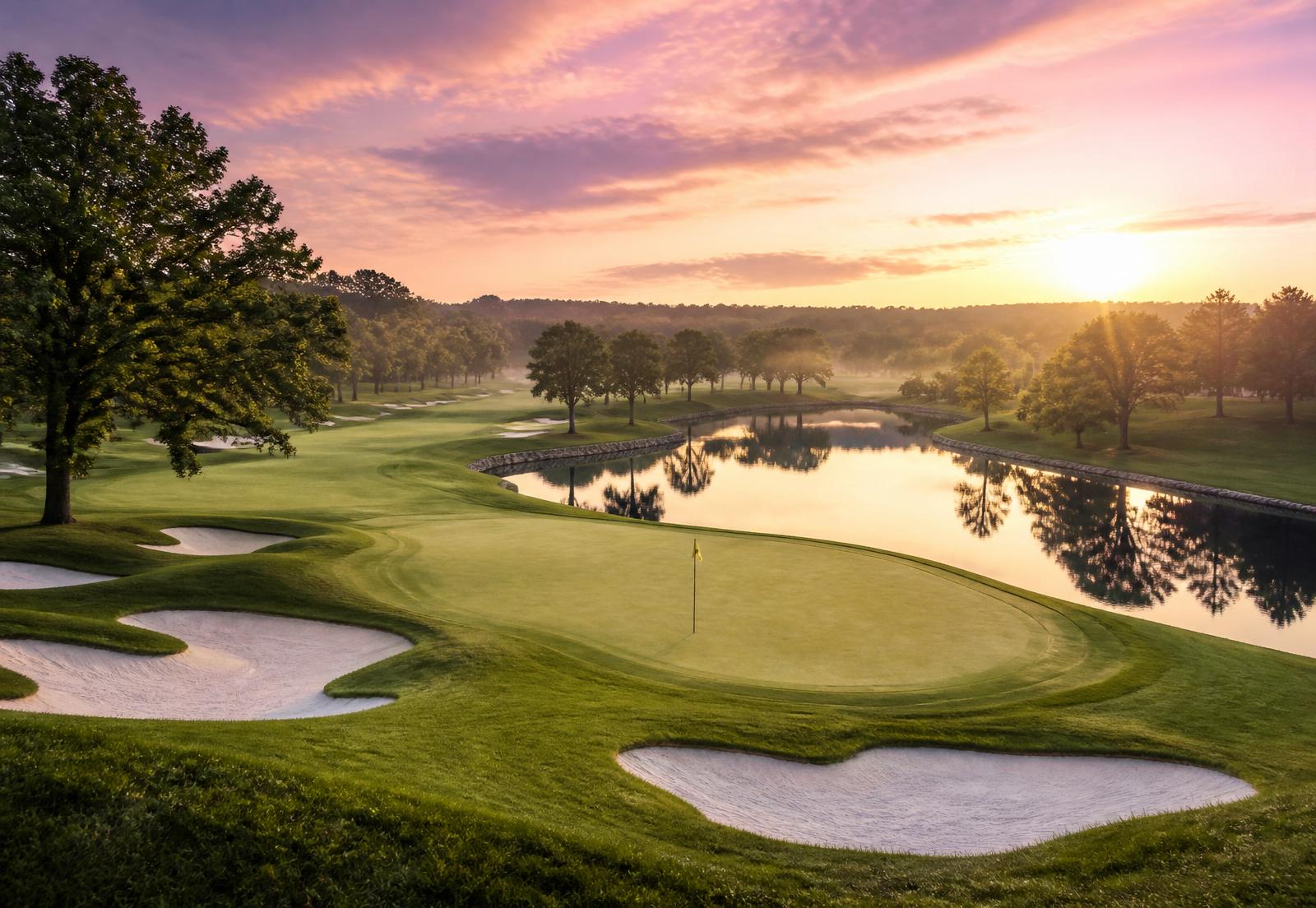
The Jack Nicklaus Signature Course
A private, championship-caliber routing carved from rolling Carolina terrain — widely regarded as one of the finest Nicklaus Signature courses in the Southeast.
Part of our complete guide to Longview Country Club.
The game of golf, at its most elemental, is a conversation between a player and the land. The finest courses are not merely built upon a site but are instead revealed from within it, their challenges and charms emerging from the native contours, vegetation, and light. At The Club at Longview, this dialogue finds its most articulate expression in the Jack Nicklaus Signature course, a design that feels less like an imposition on the landscape and more like an inevitability. It is a place that understands the subtle drama of the Carolina Piedmont, where rolling hills and mature forests of oak, hickory, and pine create a perpetually shifting canvas. The course unfolds across this terrain not as a series of isolated tests, but as a continuous narrative, each hole a chapter that builds upon the last. Here, the grand gestures of championship golf—sweeping fairways, heroic carries, and expansive greens—are carefully balanced with the quiet, strategic intricacies that reward thoughtful play and a nuanced understanding of angles and position. It is a course that speaks a language of both power and precision, demanding as much from the mind as it does from the swing.
The ‘Signature’ designation on a Nicklaus design carries with it a particular weight, signifying a level of personal involvement from the master himself that goes far beyond a cursory site visit or a rubber-stamped approval. It represents a hands-on commitment to shaping the land, to walking the fairways as they are cleared, and to personally crafting the strategic questions that each hole will ask. At Longview, this deep engagement is palpable. One senses it in the routing, which flows with a natural rhythm across the property, rising to high points that offer expansive views before descending into secluded, tree-lined corridors. One feels it in the green complexes, where subtle undulations and carefully sculpted bunkers reflect a lifetime of competitive knowledge. This is not golf architecture as a theoretical exercise; it is the practical and artful application of lessons learned over a career spent competing and winning at the highest level. The result is a course that feels both classic and contemporary, a design that honors the traditions of the game while simultaneously providing a modern, dynamic playing experience for a private membership.
To step onto the first tee at Longview is to accept an invitation to a more deliberate and considered form of the game. It is a course that requires a plan. The visual presentation is bold and clear, yet within that clarity lies a sophisticated network of strategic choices. Fairways often appear wider than they play, with optimal angles for approaching the greens guarded by deep bunkers or framed by the encroaching limbs of ancient hardwoods. Nicklaus, as a designer, has always been preoccupied with the tension between risk and reward, a theme that echoes throughout Longview’s eighteen holes. The drama is not manufactured; it is inherent in the design’s response to the landscape. It is found in the decision to challenge a fairway bunker for a shorter approach, in the temptation of a reachable par five over a protecting creek, and in the delicate touch required to navigate a multi-tiered green. This is the essence of the Longview experience: a compelling and beautiful examination of a player’s skill, strategy, and nerve, unfolding across one of the Carolinas’ most graceful and expertly rendered landscapes.
The Nicklaus Signature: A Design Philosophy
The evolution of Jack Nicklaus from the game’s greatest champion to one of its most prolific and respected architects is a story of translation. It is the story of converting an unparalleled competitive instinct and an encyclopedic knowledge of course strategy into a coherent and adaptable design philosophy. Unlike some architects who adhere to a rigid set of stylistic dogmas, Nicklaus’s approach is rooted in a pragmatic classicism, heavily influenced by the courses that shaped his own career—places like Augusta National, Pebble Beach, and the great links of Scotland. His philosophy begins with the premise that golf should be a game of thought and execution, not merely of brute force. He has long advocated for a “hard par, easy bogey,” creating courses that are playable and enjoyable for the average golfer while still demanding the utmost precision from the expert. This principle is the foundation upon which the Longview experience is built, creating a course that can be both welcoming and formidable.
At the core of the Nicklaus philosophy is a deep respect for the natural environment. His designs are celebrated for their ability to sit gently on the land, with a routing that seems discovered rather than forced. At Longview, this is expressed in the way the course flows through the property’s valleys and over its crests, utilizing the existing topography to create drama and variety. The course feels inextricably linked to the Carolina Piedmont setting, with holes framed by the indigenous hardwoods and native grasses that define the region. Nicklaus’s method involves an intensive, on-site process, walking the undeveloped land to identify natural green sites, potential hole corridors, and scenic vistas. This hands-on approach, a hallmark of the ‘Signature’ designation, ensures that the course’s character is derived directly from the site itself. The result is a palpable sense of place and an authenticity that cannot be replicated through blueprints alone.
Strategically, the Nicklaus design signature is most clearly read in the questions it asks off the tee and on the approach. Nicklaus has always favored a left-to-right ball flight, and his designs often challenge players who share that tendency while rewarding a well-executed fade. Yet, he is not a one-note designer. A great Nicklaus course provides options, and Longview is a master class in strategic diversity. The design consistently encourages players to think backward from the green, to understand that the ideal position in the fairway is dictated by the day’s pin position and the defenses of the green complex. He uses bunkering not simply as a hazard, but as a directional tool, guiding the eye and influencing the player’s strategy. This intellectual engagement is what elevates a Nicklaus Signature design; it is a course that engages the mind as much as the body, demanding a conversation between the player and the architect with every shot.
The Routing: A Journey Through the Carolina Piedmont
The routing of a golf course is its foundational poem, the narrative structure that dictates the rhythm and flow of the entire experience. A masterful routing guides the player on a journey that feels both logical and surprising, utilizing the natural strengths of a property to create a memorable and varied progression of holes. At Longview, the routing is a testament to a design team working in complete harmony with the landscape. The course moves across the rolling topography of the Carolina Piedmont with an unhurried, pastoral grace. There is a sense of exploration as the holes transition from open, upland meadows to more intimate, tree-lined corridors, creating a constant and pleasing shift in scale and atmosphere. The flow from one green to the next is intuitive, a crucial element that contributes to the course’s celebrated walkability.
The journey begins by introducing the player to the property’s grand scale, with opening holes that occupy the higher ground, offering sightlines across the course and establishing the main themes of play. As the round progresses, the routing delves into the more secluded corners of the site, where water features and mature forests come more prominently into play. This sequencing is deliberate, building the drama and the strategic challenge incrementally. There is no sense of repetition; Nicklaus and his team have artfully used the land’s movement to ensure that each hole presents a unique puzzle. A hole that plays uphill to a skyline green might be followed by a dramatic downhill shot to a fairway nestled in a valley, requiring the player to constantly adjust their strategy and shot selection to the changing terrain.
Furthermore, the routing at Longview is orchestrated to consider the movement of the sun and the prevailing winds, factors that a player may not consciously recognize but which profoundly impact the experience. The orientation of the holes means that the character of the course can shift subtly from morning to afternoon, as shadows lengthen and alter perceptions of depth and contour. The closing holes are routed with a clear sense of occasion, bringing the player back toward the stately clubhouse on a crescendo of strategic and scenic drama. This final act of the journey provides a fitting conclusion to the round, leaving the player with a lasting impression of the course’s beauty and a thoughtful summation of its architectural tenets. It is a walk that feels complete, a story well told from beginning to end.
Strategic Questions: The Short and Long Par Fours
The soul of a truly great golf course is often found in the character and variety of its par fours. These are the holes that form the strategic backbone of the round, testing every facet of a player’s game from decision-making on the tee to precision with the scoring clubs. The collection of par fours at Longview embodies this principle, offering a remarkable diversity of length, shape, and challenge. Nicklaus, a master strategist, understood that the two-shot hole should not be a monotonous exercise in repetition. Instead, he crafted a set of par fours that present a constantly shifting series of questions, demanding a full vocabulary of shots and a keen understanding of angles and position. The result is an examination that is as much intellectual as it is physical, rewarding players who can think their way around the course as well as strike the ball with authority.
Among the most compelling holes are the shorter, risk-reward par fours. These holes tempt the player with the promise of a birdie or even an eagle, but cleverly guard that reward with significant peril. A creek may cut across the fairway at a strategic distance, or a constellation of deep bunkers might pinch the ideal landing area, forcing a decision between laying back for a safe, longer approach or taking an aggressive line that brings trouble into play. The greens on these shorter holes are often complex and well-defended, ensuring that even a successful tee shot is no guarantee of a simple second. This design element—the drivable or near-drivable par four—is a hallmark of Nicklaus’s later work, reflecting his belief that golf should be an exciting and engaging enterprise, full of dramatic choices.
In contrast, the longer par fours at Longview present a more traditional, but no less strategic, challenge. These holes demand strong and accurate tee shots to find the proper portion of the fairway for the best approach angle. They often play into the prevailing wind or feature subtly elevated greens that require an extra club. The bunkering on these holes is placed to penalize the slightly errant shot and to frame the ideal line of play. Nicklaus masterfully uses the natural contours of the land on these longer holes, with fairways that cant and slope, requiring the player to account for the ball bouncing and rolling away from the target. Successfully navigating these holes provides a deep sense of satisfaction, a feeling of having met a stern and honest test of one’s ball-striking and course-management skills.
Scoring Opportunities: The Reachable Par Fives
Par fives in the Nicklaus design portfolio are rarely just long holes; they are strategic narratives with a clear dramatic arc. They are the designer’s invitation to gamble, to weigh the potential for a heroic eagle against the risk of a high number. At Longview, the par fives are among the most memorable and pivotal holes on the course, a collection of scoring opportunities that are both tempting and treacherous. Each one is designed as a true three-shot hole for the majority of players, yet offers the long and accurate hitter a compelling reason to attempt the green in two. This inherent tension is the essence of their design, making them critical junctures in any competitive or casual round.
The art of the reachable par five lies in the complexity of the second shot. The decision is never simple. Nicklaus has ensured that going for the green in two at Longview is always a calculated risk. A creek might guard the front of the green, demanding a perfectly struck shot with sufficient carry. On another hole, the green might be perched on a promontory, with steep fall-offs on multiple sides, meaning that a shot that is only slightly off-line can carom away, leaving a delicate and challenging recovery. Bunkers are positioned not just to catch poor shots, but to challenge the very concept of the heroic attempt, forcing players to aim for a small, precise target if they wish to be rewarded. The psychological element is immense, as the possibility of a low score can cloud judgment and lead to strategic errors.
For the player who chooses the more conservative, three-shot route, the strategy does not diminish. The layup shot is just as important, requiring careful placement to a specific yardage and angle. Nicklaus designs the layup zones with as much care as the green complexes themselves, often using fairway contours and bunkering to define the optimal position for the third shot. A well-played layup can leave a relatively straightforward pitch, while a poorly considered one can result in a difficult, awkward approach from a poor angle or uneven lie. This ensures that the hole remains engaging for every player, regardless of their length off the tee. The par fives at Longview are, therefore, a complete test of a player’s game: power, precision, and, above all, strategic planning.
A Signature Aesthetic: Bunkering and Green Complexes
If the routing provides the course’s structure, the bunkering and green complexes provide its distinctive voice and character. It is here, in the fine details of the shaping, that the architect’s style is most clearly revealed. At Longview, the aesthetic is one of bold, classic forms, where bunkers are not merely decorative but are integral to the strategic and visual composition of each hole. The bunkering is characteristically Nicklaus: large, often deep, and meticulously placed. They serve multiple purposes—as hazards for the truly errant shot, as directional guides that suggest the ideal line of play, and as framing elements that create a strong and pleasing visual aesthetic from the tee or fairway.
The style of the bunkers at Longview is notable for its clean, defined edges and the way they are cut into the surrounding landforms. They often feature steep grass faces that can turn a seemingly simple sand shot into a complex recovery. Their placement is highly strategic, defending the inside corner of doglegs, protecting the optimal landing areas in fairways, and, most importantly, guarding the greens. Greenside bunkers are positioned to challenge specific pin locations, meaning a player’s approach shot must be executed with a clear plan in mind. A front-left pin may be protected by a deep bunker on that side, while a back-right pin may require a high, soft shot over a sand trap that looms just short and right of the putting surface. This dynamic relationship between pin position and bunkering ensures that the course plays differently every day.
The green complexes themselves are the culmination of each hole’s strategic journey. The putting surfaces at Longview are generous in size, a common Nicklaus trait, but this size is used to create distinct sections or tiers, effectively creating smaller targets within the larger green. The undulations are often subtle but significant, rewarding a player who has placed their approach shot on the correct level and leaving a challenging two-putt for those who have not. The surrounds are just as important, with tightly mown runoff areas that can whisk a slightly misjudged shot away from the green, demanding a deft touch with a wedge or putter to recover. This combination of contoured greens, strategic bunkering, and thoughtfully designed surrounds creates a sophisticated and endlessly engaging short-game challenge, the final and most precise test on each hole.
The Challenge Calibrated: Playability and Mastery
A private club’s golf course must perform a delicate balancing act. It must be a place where members of all abilities can find enjoyment and a fair challenge, while also providing a stern test for the highly skilled player. This concept of calibrated challenge is a cornerstone of the Nicklaus design philosophy and is executed with masterful subtlety at Longview. The course’s playability is not achieved by simply dumbing down the design, but by building strategic options and multiple paths into the fabric of every hole. It is a course that can be played on many levels, revealing more of its complexity as a player’s skill and understanding grows.
The most visible evidence of this philosophy is the extensive system of teeing grounds on each hole. Longview typically offers a range of options, allowing the course to be played at substantially different lengths. This is far more than just a matter of moving markers forward or back; the entire strategic character of a hole can change from a different tee. The angle of the tee shot is altered, bringing a fairway bunker into play from one tee that may not be a factor from another. The length of a forced carry over a hazard is adjusted. A long par four from the championship tee becomes a mid-length hole from the member’s tee, requiring a different approach strategy. This ensures that players are able to play the course from a length that matches their ability, allowing them to experience the architect’s intended strategies rather than being overwhelmed by sheer distance.
Beyond the tee boxes, playability is woven into the design in more nuanced ways. The openings to many greens are wider at the front, allowing for a running approach shot for those who may not have the ability to fly the ball to the target. While optimal landing areas are well-defended, there is often a safer, more conservative route that leaves a longer or more complicated second shot but avoids major trouble. Nicklaus provides an “out” on many holes. However, for the player seeking mastery, a different and more demanding course reveals itself. To score well consistently, one must challenge the hazards, shape the ball to fit the hole, and land it in precise, elevated target zones. Longview’s genius lies in this duality: it is a welcoming home course for a friendly afternoon game, and simultaneously, a sophisticated championship venue capable of testing the very best.
The Art of Agronomy: A Canvas of Turf
The architectural vision of a golf course, no matter how brilliant, can only be fully realized through the science and art of agronomy. The quality of the playing surfaces—the firmness of the fairways, the purity of the greens, and the consistency of the rough—is what allows the strategic design to function as intended. At Longview, the commitment to superior turfcraft is evident from the first step onto the manicured grounds. The club maintains a standard of conditioning that is not merely about aesthetic perfection, but about optimizing the playability of the Nicklaus design. The turf is not just a carpet for the game; it is an integral part of the strategic matrix.
The fairways at Longview are maintained to be firm and fast, a condition that promotes the ground game and rewards thoughtful shot placement. This allows a well-struck tee shot to bound and roll, bringing the strategic placement of fairway bunkers and contours into sharp focus. A soft, overly lush course can neutralize architectural intent, but Longview’s agronomic program ensures that the ball’s interaction with the ground is a key part of the experience. This emphasis on firmness extends to the areas around the greens, where tightly mown surrounds and collection areas provide a variety of short-game options, from a delicate chip to a creative putt from well off the putting surface. The choice of turfgrasses is critical, selected for their suitability to the local climate and their ability to produce these elite playing conditions throughout the seasons.
Nowhere is the agronomic standard more critical than on the putting greens. The greens at Longview are renowned for their speed, smoothness, and consistency. This allows the subtle and bold contours designed by Nicklaus to be the primary factor in the challenge of putting. When greens are pure, the player can trust their read and their stroke, knowing that the ball will roll true to the line it is started on. The daily maintenance practices, from mowing and rolling to moisture management, are a meticulous science aimed at presenting the greens at their peak potential each day. This dedication ensures that the final act of each hole—the putting—is a true test of skill, and that the architectural integrity of the green complexes is honored.
The Walking Golfer's Domain
In an era where the golf cart has become ubiquitous, the experience of walking a course offers a more intimate and traditional connection to the game. It allows for a deeper appreciation of the land, a better understanding of the subtleties of the routing, and a rhythm of play that many find more engaging and rewarding. The Club at Longview was designed from its inception to be a walker’s course, and this sensibility is a defining part of its culture. The layout flows seamlessly from each green to the next tee, often just a short, thoughtful stroll away. This deliberate routing avoids the long, disconnected transitions that mar the walking experience at many modern courses, creating a continuous and immersive journey through the landscape.
The walkability of Longview is more than just a matter of proximity between holes. It is about the quality of the journey itself. The paths and connections are as carefully considered as the fairways, guiding the walker through stands of mature trees, over gentle rises, and past the quiet, reflective surfaces of the course’s water features. Walking allows the player to observe the subtle shifts in topography, to feel the firmness of the ground beneath their feet, and to see how the holes fit together to form a cohesive whole. It fosters a sense of discovery and a slower, more deliberate pace that seems perfectly attuned to the strategic nature of the Nicklaus design. The game becomes less about racing from shot to shot and more about the process and the environment.
This commitment to the walking tradition is further enhanced by the club’s professional caddie program. Having a caddie is not merely a convenience; it enriches the experience immeasurably. A knowledgeable caddie provides more than just yardages and green reads; they offer a deeper understanding of the course’s strategy, sharing insights into the ideal lines of play and the subtle nuances of the design that might otherwise go unnoticed. The conversation with a caddie, the shared walk down the fairway, and the camaraderie of navigating the course’s challenges together are all part of a classic golfing tradition that Longview actively cultivates. It is a testament to the club’s understanding that the way one experiences a golf course is just as important as the design of the course itself.
Landmark Holes: A Collection of Moments
While a great course is defined by its overall consistency and flow, it is often remembered through a collection of distinct, indelible moments. These are the landmark holes that encapsulate the essence of the design and leave a lasting impression on the player. At Longview, these moments are plentiful, each one a postcard from the architect’s imagination. They are not defined by extreme difficulty, but by their strategic interest, their scenic beauty, and the dramatic questions they pose. One such moment arrives on a par three that plays over a reflective pond to a green set against a backdrop of dense, mature hardwoods. The shot is all carry, a pure and nerve-wracking test of iron play, where the beauty of the setting provides a stark and compelling contrast to the precision required.
Another memorable chapter in the Longview story is a sweeping, dogleg-right par four that demands a confident tee shot to a fairway framed by a massive, ancient oak on the inside of the turn and a series of deep bunkers on the outside. The hole is a master class in strategic design, offering a clear choice from the tee: a shorter, more dangerous route that flirts with the tree, or a safer line to the left that leaves a significantly longer approach. The green is perched subtly above the fairway, making the second shot play a half-club longer than the yardage suggests. It is a hole that combines natural beauty, classic architecture, and strategic decision-making in perfect harmony.
The round often reaches a crescendo on the closing holes. One of the final par fives, for example, offers a dramatic risk-reward scenario that can define a match. A creek winds its way down the entire right side of the hole and cuts directly in front of the green, creating a formidable obstacle for the player attempting to get home in two. The layup is no simple matter either, as the fairway narrows and tilts toward the hazard in the ideal landing area. As the round concludes, a formidable finishing hole often plays uphill toward the magnificent clubhouse, which serves as a majestic backdrop. The final approach shot, with the gallery of the clubhouse terrace in view, is a fittingly grand conclusion to a round that is rich with strategic substance and aesthetic reward.
The Practice Grounds: A Space for Refinement
The quality of a club’s practice facilities is a direct reflection of its commitment to the game itself. It is a statement about whether the club is merely a place to play, or a place to truly improve and refine one’s skill. The practice grounds at Longview are not an afterthought; they are an integral part of the golf experience, designed and maintained with the same meticulous care and attention to detail as the course itself. This cohesive approach ensures that the work a member puts in on the range or the short game area translates directly to the challenges they will face on the course. The turf, the targets, and the overall environment are all designed to simulate on-course conditions, making practice more purposeful and effective.
The driving range is an expansive, double-ended facility that allows players to practice every club in the bag from high-quality turf. The landing areas are not simply open fields; they feature target greens guarded by bunkers, allowing for the rehearsal of specific shots to simulated fairways and greens. This encourages a more strategic form of practice, where a player can work on shaping shots and controlling trajectory rather than just mindlessly hitting for distance. The presence of these targets provides immediate and useful feedback, mimicking the visual and strategic context of a real golf hole and making the transition from the range to the first tee a seamless one.
Beyond the full swing, Longview’s commitment to game improvement is most evident in its extensive short game facilities. There are dedicated areas for chipping, pitching, and bunker play, each presenting a variety of lies and scenarios. One can practice short pitches from tight lies, delicate flop shots from thicker grass, and recovery shots from the same style of deep, strategically placed bunkers found on the course. Multiple putting greens, each maintained to the same speed and firmness as the course greens, allow for the practice of both short, technical putts and long, lagging efforts over significant contours. These facilities are more than just a warm-up spot; they are a comprehensive workshop for the scoring game, providing a member with every tool they need to sharpen the most critical parts of their play.
A Regional Cornerstone: Nicklaus in the Carolinas
The Charlotte region and the broader Carolina landscape are home to a number of courses bearing the Jack Nicklaus name, a testament to the area’s status as a serious golf destination. However, these courses exist on a spectrum, and the ‘Nicklaus Design’ versus ‘Nicklaus Signature’ designation is a distinction with a significant difference. A ‘Nicklaus Design’ course is crafted by the formidable and talented team at his firm, following his well-established philosophies. A ‘Jack Nicklaus Signature Course,’ conversely, denotes a much higher level of personal, hands-on involvement from Nicklaus himself. Longview belongs to this more exclusive category, placing it in a different class of architectural authorship and prestige.
This personal oversight from the Golden Bear is what sets Longview apart. While other Nicklaus-affiliated courses in the region may share certain philosophical traits—such as strategic bunkering and an emphasis on the second shot—Longview exhibits a level of nuance and site-specific detail that speaks to a more intimate design process. The way the course is so gracefully routed across the site’s most compelling natural features, the subtlety in the contouring of the green complexes, and the rhythm and flow of the walk all point to the master’s touch. It is less a product of a successful design company and more the work of a singular artist engaging with a unique canvas.
Within the context of premier private golf in the Charlotte metro area, Longview occupies a distinct niche. It is a pure golf experience, presented with a level of refinement and service that is commensurate with its architectural pedigree. It is not a course built around a real estate development, but rather a course that stands as the centerpiece of a community dedicated to a certain quality of life. Its reputation is built not on a single televised tournament, but on the enduring quality of its design and the day-to-day experience it provides its members. In the constellation of Carolina golf, it shines as a prime example of the Nicklaus Signature philosophy realized to its fullest and most artful potential.
Questions & Answers
What does the ‘Jack Nicklaus Signature’ designation signify?
The 'Jack Nicklaus Signature' designation indicates the highest level of personal involvement from Mr. Nicklaus in the design process. It means he personally directed the course layout, walked the site extensively during its creation, and had final approval over all strategic and aesthetic elements, distinguishing it from courses created by his design firm with less direct oversight.
How does the course design favor a particular style of play?
The course is strategically designed to reward thoughtful, well-placed shots over pure power. While it is a strong test from the back tees, its nuances favor a player who can shape the ball and who thinks backward from the green, understanding the importance of approach angles. A controlled fade, Mr. Nicklaus’s own preferred shot shape, is often rewarded.
Is The Club at Longview considered a difficult course?
The course's difficulty is intentionally adaptable, a concept Jack Nicklaus describes as 'hard par, easy bogey.' From the championship tees, it is a formidable challenge capable of testing the most accomplished players. However, thanks to a wide variety of teeing grounds, the course is enjoyable and playable for members of all skill levels, ensuring the challenge is appropriate to the player.
How walkable is the course?
The course was designed with the walking golfer in mind and is considered exceptionally walkable. The routing features short and logical transitions from greens to the next tees, creating a seamless and immersive journey through the landscape. The club actively fosters a walking culture, further enhancing this traditional aspect of the game.
What is the role of the caddie program?
The caddie program is a central part of the Longview experience, intended to elevate the traditional nature of the game. Professional caddies provide strategic insights, read greens, and manage all on-course needs for the player. Using a caddie enriches the walk and allows for a deeper appreciation of the course’s architectural subtleties.
What type of turfgrass is used on the playing surfaces?
The club uses specific, high-quality turfgrasses best suited for the climate of the Carolina Piedmont and for producing championship-level playing conditions. The greens are typically a modern strain of bentgrass, known for its ability to be maintained for speed and smoothness. The fairways and tees consist of a durable bermudagrass base, providing firm and fast conditions throughout the primary playing seasons.
How does the course change with the seasons?
The course offers a different experience throughout the year. In the spring, the native flowering trees and lush conditions create a vibrant backdrop. In summer, the firm and fast bermudagrass fairways are at their peak, promoting the ground game. The autumn brings spectacular foliage from the surrounding hardwoods, creating a stunning visual tapestry and adding a different feel to the experience.
What makes the practice facilities notable?
The practice grounds at Longview are notable for being designed and maintained to the exact same standards as the course itself. The driving range includes target greens that simulate on-course shots, and the extensive short-game area has dedicated spaces for chipping, pitching, and bunker play from a variety of lies. This allows for purposeful practice that translates directly to improved on-course performance.
How does Longview compare to other top-tier Charlotte-area courses?
Longview distinguishes itself through its exclusive 'Jack Nicklaus Signature' pedigree, which signifies a level of architectural detail and personal oversight from the designer that is rare. It provides a pure golf experience in a private, refined setting, with a reputation built on its classic design principles and consistently elite course conditioning rather than on hosting large-scale public events.
Are there any water hazards on the course?
Yes, water hazards are a significant and strategic element of the design. Creeks and ponds are used to create risk-reward opportunities and to defend the greens on several key holes, including some of the most dramatic par threes and par fives. The water features are integrated naturally into the landscape, adding to both the beauty and the challenge of the course.
The Houses Behind This Guide
A short list of firms Longview owners rely on for property, design, construction and technology. Each keeps its own website, and every conversation happens there rather than here.
Peters & Associates, Inc.
When an estate inside the gates changes hands quietly, it is usually this desk on one side of the table.
Emerald & Oak Design
A small studio with a long memory for proportion, working in plaster, oak, stone and restrained color.
Peters Custom Homes, Inc.
The builder behind a number of Longview's most considered houses, and the renovations that quietly saved others.
Peters Audio Video
Sound, cinema, lighting and control designed to disappear into the architecture instead of competing with it.
The Peters Team
The people who actually walk the streets here — street by street, lot by lot, on behalf of a private client roster.