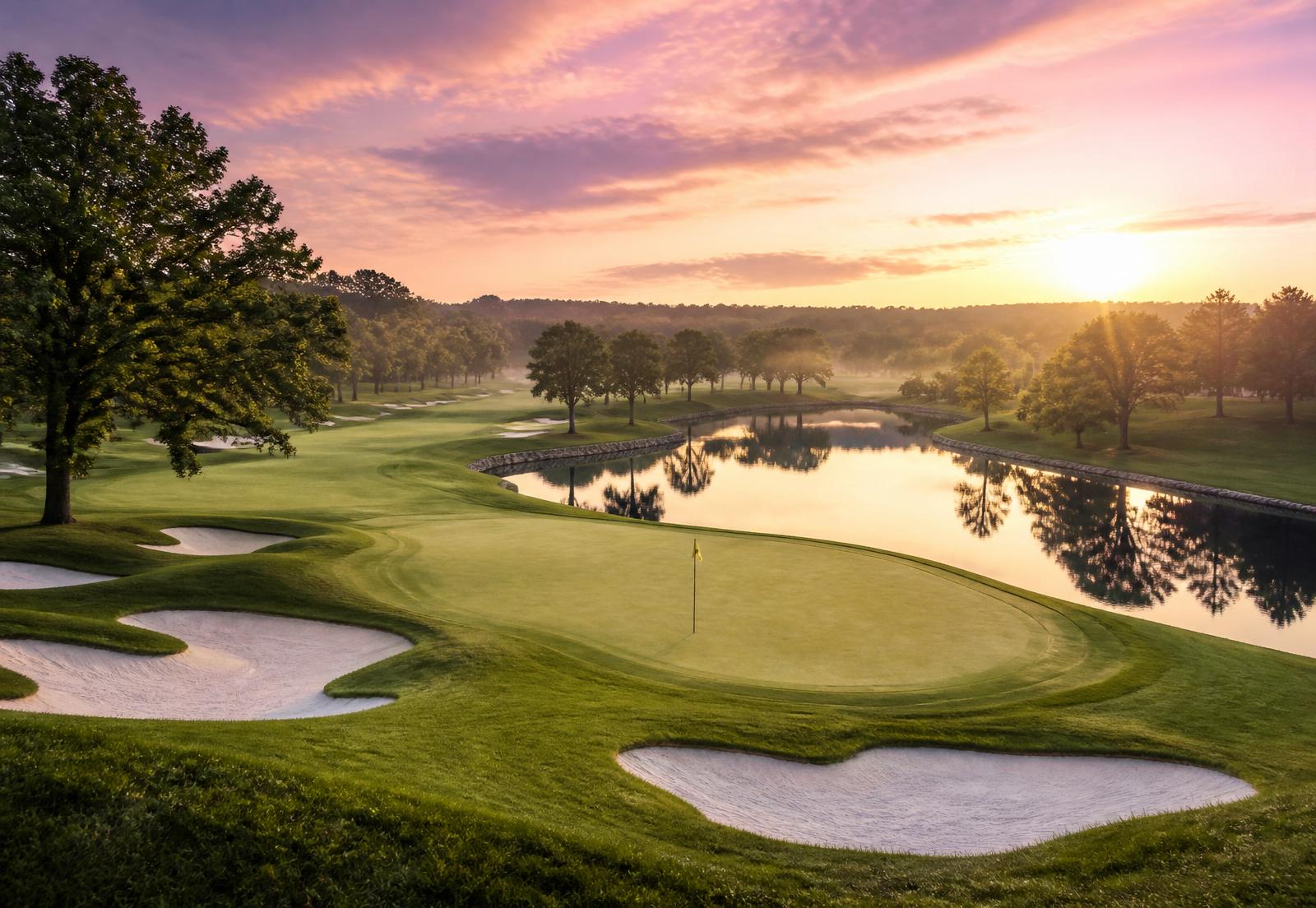
The Longview Golf Course
An independent guide to the Jack Nicklaus Signature course, the experience of playing here, and the character of private golf in the community.
Golf at The Club at Longview
The golf course is the organizing fact of the community. Longview was routed around it, the streets follow it, the clubhouse addresses it, and a meaningful fraction of the homes look onto it. Understanding the course — its design intent, how it plays, how it is conditioned, and how it compares to the other serious golf in the Charlotte region — is therefore not a niche interest for golfers. It is central to understanding the property market and the membership proposition alike.
This section covers the Jack Nicklaus Signature design itself, the practice complex, the member experience and tournament culture, and the wider regional context: how Longview sits among Charlotte-area private courses, and how it fits within the catalog of Nicklaus designs across North Carolina.
As with everything on this site, the coverage here is independent editorial analysis. Course conditions, programming, and access policies change; verify specifics with the club directly.
The Nicklaus Signature Design
A Nicklaus Signature course carries a specific meaning: Nicklaus was personally involved in the routing and design decisions rather than lending a name to associate work. The design language that results is recognizable to anyone who has played several of them — generous but strategically shaped landing areas, greens that reward approach shots from a particular side, bunkering that punishes the lazy line rather than the miss, and a preference for asking the golfer to make a decision on the tee rather than simply to execute.
At Longview that philosophy meets a piedmont site with real elevation change, mature hardwood stands, and water features that were integrated into the routing rather than imposed on it. The result is a course that presents very differently from the tips than from the member tees — a common Nicklaus characteristic and a deliberate one. A scratch player faces genuine architectural resistance; a fifteen-handicap playing the appropriate set of tees finds a course that is demanding but fair.
The routing also does something that matters enormously for the surrounding real estate: it maintains separation. Holes are not stacked corridor-against-corridor with houses squeezed between. That decision cost homesites and bought both playing quality and residential privacy — a tradeoff the community has benefited from for two decades.
Conditioning and Agronomy
Conditioning is where private clubs distinguish themselves most visibly, and it is the dimension members discuss most. The piedmont's transition-zone climate is genuinely difficult turf territory: hot, humid summers that stress cool-season grass and winters cold enough to dormant warm-season grass. Every serious club in the region is managing that tension, and the choices made about greens surfaces, fairway grass, overseeding, and aerification schedules determine what the course actually feels like across the calendar.
Practically, this means the honest answer to 'how are conditions?' is seasonal. Late spring and fall generally present the course at its best. Deep summer tests the greens. Aerification windows are unavoidable and every club schedules them. Prospective members evaluating a course should, whenever possible, see it in more than one season before drawing conclusions.
The Practice Complex and Player Development
For families, the practice facility often matters more than the championship course. A serious short-game area, a range with adequate depth and target definition, and a putting complex that replicates the greens' actual speed and contour are what make sustained improvement possible — and what make junior programming viable.
Longview's practice complex supports full-swing work, short game, and putting, and it anchors the club's instruction and junior development programming. Households evaluating clubs primarily on the merits of the eighteen holes frequently underweight this, then discover that the practice area is where they actually spend most of their time.
Regional Context
Charlotte is a strong golf market with an unusual concentration of quality private courses within a thirty-mile radius — Quail Hollow, Charlotte Country Club, Myers Park, Carmel, Providence, Ballantyne, Firethorne, and others, each with a distinct character, membership culture, and cost structure. Longview competes in that set on the strength of its design pedigree, its conditioning, and the fact that its membership is drawn substantially from within the gates, which produces a different social texture from a commuter club.
North Carolina also holds a notable cluster of Nicklaus designs, which gives context for what the Longview course is doing architecturally. The dedicated guides in this section cover both comparisons: Charlotte-area private courses generally, and Nicklaus designs across the state specifically.
The Jack Nicklaus Course
A private, championship-caliber routing widely regarded as one of the finest in the Southeast.
Golf Experience
The rhythm of a day on the course — arrival, round, and after-round.
Longview Country Club Guide
The complete independent guide to The Club at Longview — golf, membership context, homes, and community.
Course Tour
An editorial walk through the shape of the round.
Practice Facilities
Range, short game, and instruction context.
About The Longview Golf Course
Who designed the golf course at Longview?
The Longview course is a Jack Nicklaus Signature design — meaning Nicklaus was personally involved in the routing and design decisions, not just brand-licensed.
Is the golf course open to the public?
No. Longview is a private club; play is restricted to members and their accompanied guests.
How much does Longview membership cost?
Initiation and dues vary by category (full golf, social, etc.) and change over time. The Longview Membership Cost guide explains how to think about total cost of belonging.
Are practice facilities available to members?
Yes. Longview offers a full-length range, short-game area, and putting greens for member practice. See the Longview Practice Facilities guide.
The Houses Behind This Guide
A short list of firms Longview owners rely on for property, design, construction and technology. Each keeps its own website, and every conversation happens there rather than here.
Peters & Associates, Inc.
When an estate inside the gates changes hands quietly, it is usually this desk on one side of the table.
Emerald & Oak Design
A small studio with a long memory for proportion, working in plaster, oak, stone and restrained color.
Peters Custom Homes, Inc.
The builder behind a number of Longview's most considered houses, and the renovations that quietly saved others.
Peters Audio Video
Sound, cinema, lighting and control designed to disappear into the architecture instead of competing with it.
The Peters Team
The people who actually walk the streets here — street by street, lot by lot, on behalf of a private client roster.