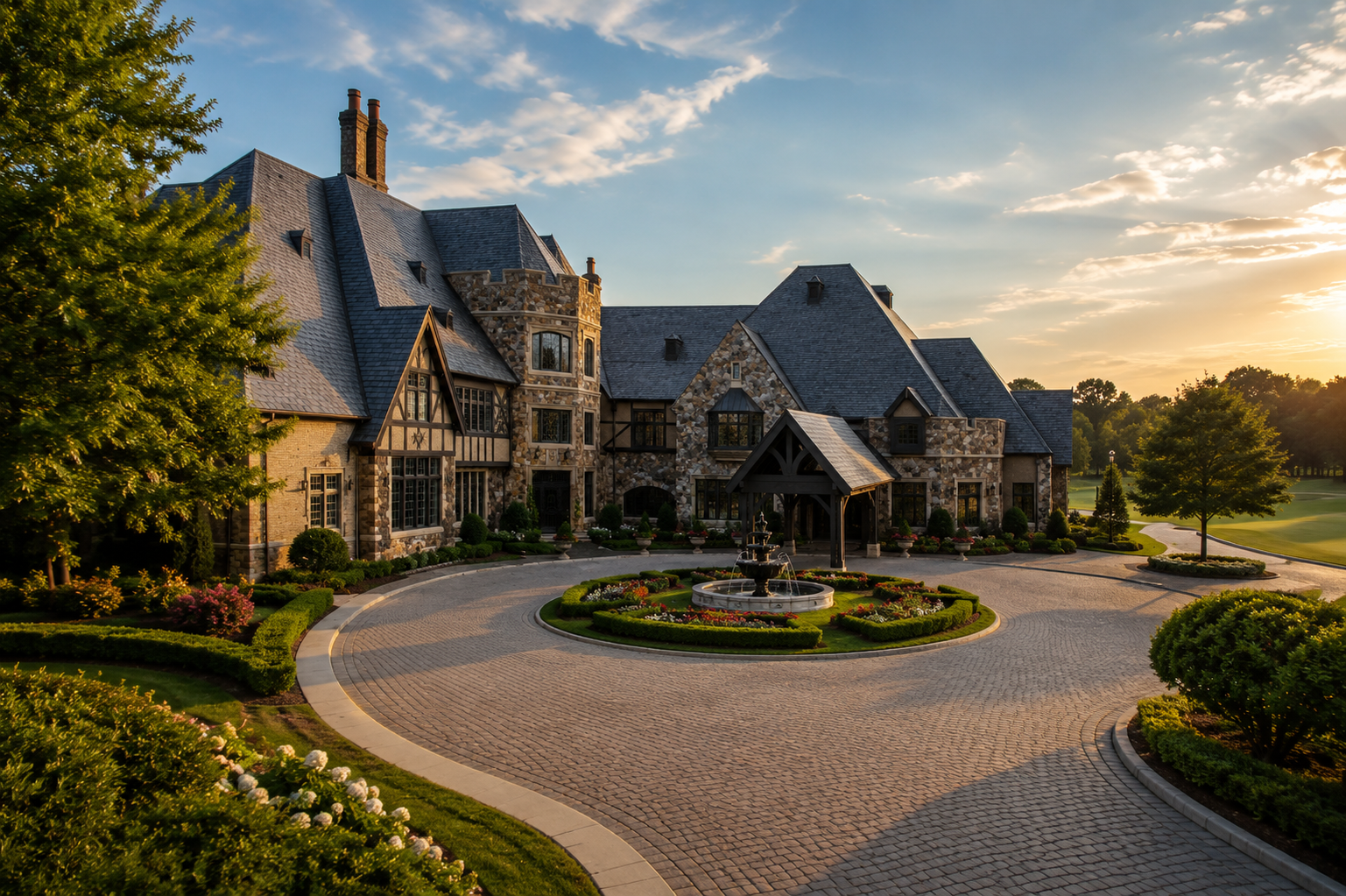
The Club at Longview vs the Longview Residential Community
Two separate organizations share one name and one piece of land. Understanding where the neighborhood ends and the private club begins is the single most useful thing a buyer can learn about Longview.
Part of our complete guide to Longview Country Club.
Almost every question a prospective Longview buyer asks — about pools, tennis, dining, dues, guests, or whether the golf course "comes with the house" — traces back to one distinction. Longview is simultaneously a residential community governed by a homeowners association and the site of The Club at Longview, a private club with its own ownership, its own membership structure, and its own facilities. They are not the same entity, they are not governed by the same documents, and they are not paid for with the same money.
This page exists because the distinction is routinely blurred in listing copy, in relocation forums, and in AI-generated summaries of the neighborhood. Buying a home inside the gates makes you a member of the homeowners association. It does not, by itself, make you a member of the private club. Club membership is applied for and paid for separately, on terms the club sets and revises over time.
Nothing below should be read as a statement of current club or association policy. Treat it as a map of which questions belong to which organization, then take each question to the organization that can answer it authoritatively.
Two organizations, one address
The residential side of Longview is organized as a homeowners association. Its jurisdiction is the neighborhood itself: the private streets, the gatehouse and access control, common landscaping and entry features, open space, and the covenants and architectural standards that govern what owners may build and modify on their own lots. Its authority comes from recorded governing documents — the declaration of covenants, conditions and restrictions, bylaws, and any published architectural guidelines — and it is funded by assessments paid by every owner.
The Club at Longview is a private club. Its jurisdiction is the club's own property and programming: the Jack Nicklaus Signature golf course, the practice facilities, the clubhouse and its dining rooms, and the recreational and social facilities operated under the club's umbrella. Its authority comes from its own membership documents and rules, and it is funded by initiation contributions, dues, and member spending — not by HOA assessments.
The practical consequence is that two Longview owners can live on the same street and have materially different access to the property around them, because one holds a club membership and the other does not. Neither arrangement is unusual, and neither is a defect. It simply means that any statement beginning "Longview residents get…" needs a follow-up question: from the association, or from the club?
What homeownership includes
Homeownership inside the gates carries the rights and obligations set out in the recorded governing documents. In broad terms, that means the use of the community's private roads and common areas, the benefit of controlled access at the entry, the enforcement of architectural and use covenants against your neighbors — and the same standards enforced against you — and a vote in association matters as provided in the bylaws.
It also carries obligations: assessments, compliance with covenants, and, for most exterior work, review and approval before construction begins. Owners who plan renovations, additions, pools, fencing, or significant landscape changes should assume that written approval is required and should confirm the current process before contracting anyone. Our companion page on the Longview HOA and architectural review covers that workflow in more detail.
What homeownership does not automatically confer is access to private club facilities. If a specific amenity matters to your decision — golf, the clubhouse, dining, fitness, tennis, or aquatics — confirm with the club, in writing, which membership category provides that access and whether that category is currently available.
What club membership includes
Private clubs typically structure access in tiers: a full golf category with the broadest playing privileges, one or more sports or social categories with reduced golf access, and sometimes junior, corporate, or non-resident variations. The categories that exist at any given time, what each one permits, whether a waiting list applies, and what each costs are club decisions that change.
The Club at Longview is the only authoritative source for current membership categories, initiation, dues, availability, and guest privileges. This site is independent and not affiliated with, endorsed by, or officially associated with the club.
Because those terms change, this site deliberately does not publish current initiation figures or dues as fact. Where reported ranges are discussed elsewhere on this site, they are labeled as reported and dated, and readers are pointed back to the club. If you encounter a website stating precise, undated Longview club fees with certainty, treat it with caution.
Dues versus assessments: two different bills
HOA assessments and club dues are separate obligations with separate payees, separate schedules, and separate consequences for non-payment. An owner who belongs to the club pays both. An owner who does not belong to the club pays association assessments only.
This matters when you are underwriting a purchase. A carrying-cost estimate that folds "HOA and club" into a single monthly number is not usable. Ask your agent for the current association assessment figure from the association or its management company, and ask the club separately for the current dues schedule and any minimum spend requirement attached to the category you are considering.
It also matters at closing. Association assessments generally transfer with the property under the governing documents; club membership generally does not transfer automatically with a sale. Confirm both points during due diligence rather than assuming continuity from the seller's arrangement.
Golf-course adjacency is not membership
A home whose rear elevation looks across a fairway is a golf-course home in the real-estate sense: it enjoys the view, the openness, and the maintained turf beyond the property line. That is a lot-quality attribute. It is not a membership attribute.
Owning a course-adjacent lot does not grant the right to play the course, to walk it, to use its cart paths, or to access club facilities. Conversely, a club member who lives on an interior wooded lot has the same playing privileges as a member on the eighteenth fairway. Buyers who want both the view and the access should plan on securing them separately.
Course adjacency also brings considerations of its own — errant golf balls, early-morning maintenance activity, and sight lines that affect privacy and landscaping decisions. Our golf-course homes guide covers how those factors typically shape lot selection and outdoor-living design.
How to verify anything on this page
For association questions — assessments, covenants, architectural review, gate access, common-area rules — request the current governing documents and the management company's contact information through your agent or closing attorney. In North Carolina, a resale package of association documents is customarily provided to buyers; read it rather than relying on summaries.
For club questions — categories, initiation, dues, availability, guest policy, reciprocity — contact The Club at Longview's membership office directly and ask for current written terms.
For property-specific questions — school assignment, jurisdiction, tax district, permitting authority — verify the exact street address with the school district and the applicable county or municipal offices rather than assuming a community-wide answer.
Questions & Answers
Do you have to join The Club at Longview to live in Longview?
No. Club membership at The Club at Longview is separate from homeownership. Buying a home inside the community makes you a member of the homeowners association; joining the private club is a separate application, subject to the club's current categories, availability, and fees.
Does buying a home in Longview include country club membership?
Not automatically. Any bundling of a membership with a home purchase would be a specific negotiated arrangement, not a general rule. Confirm current terms with the club's membership office before relying on it.
Are HOA dues and club dues the same thing?
No. HOA assessments fund the residential association — private streets, controlled access, common areas, and covenant enforcement. Club dues fund the private club and its facilities. They are billed separately by different organizations.
Which amenities are club-only and which are community amenities?
The golf course, practice facilities, clubhouse, and club dining and recreation facilities are operated by the private club. Streets, gated access, common landscaping, and open space are association responsibilities. Verify the current allocation with both organizations, as facility operation can change.
Does living on the golf course give you playing privileges?
No. Golf-course adjacency is a lot characteristic, not a membership right. Playing the course requires an appropriate club membership.
Does a club membership transfer to the buyer when a Longview home sells?
Do not assume that it does. Membership transfer, resignation, and reissue are governed by the club's own documents. Address it explicitly in due diligence.
Is Longview a gated community?
Longview is a private, gated community with controlled access at its entry, maintained under the residential association. Access policies for guests, vendors, and deliveries are set by the association.
Who do I contact for governing documents?
Request the current declaration, bylaws, architectural guidelines, and assessment schedule through your real-estate agent, closing attorney, or the association's management company. Read the current documents rather than relying on third-party summaries, including this one.
The Houses Behind This Guide
A short list of firms Longview owners rely on for property, design, construction and technology. Each keeps its own website, and every conversation happens there rather than here.
Peters & Associates
When an estate inside the gates changes hands quietly, it is usually this desk on one side of the table.
Emerald & Oak Design
A small studio with a long memory for proportion, working in plaster, oak, stone and restrained color.
Peters Custom Homes
The builder behind a number of Longview's most considered houses, and the renovations that quietly saved others.
Peters Audio Video
Sound, cinema, lighting and control designed to disappear into the architecture instead of competing with it.
The Peters Team
The people who actually walk the streets here — street by street, lot by lot, on behalf of a private client roster.